
Understanding Base Stations and Precision Farming with FarmDroid
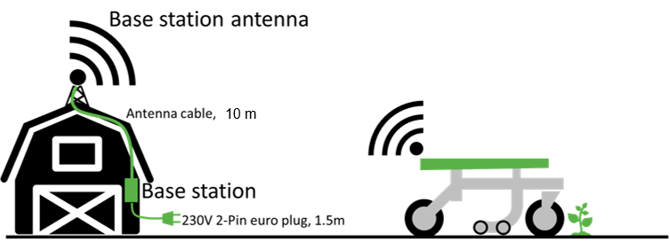
The Base Station is a critical part of the FarmDroid FD20 system. It provides the robot with a real-time corrected RTK-GNSS signal, enabling the centimeter-level accuracy required for precision tasks such as seeding and in-row weeding.
To maintain this precision, it is important to understand how Base Stations affect field setup and robot operation throughout the season.
Why does the same Base Station matter?
Each Base Station creates a unique reference point that the robot uses for navigation. When a field is created, all driving patterns and coordinates are linked to the Base Station used during setup.
For this reason:
- A field should always be operated using the same Base Station that was used when the field was originally created.
- Switching to a different Base Station will shift the robot's reference point, causing inaccuracies that cannot be corrected.
- Moving the Base Station antenna, even slightly, will have the same effect because the robot's reference system is based on the antenna's exact position.
To ensure consistent accuracy throughout the season, the Base Station antenna must remain fixed in the same location, and each field must stay connected to its original Base Station.
Why does the same Base Station matter?
A Base Station provides reliable RTK corrections within a radius of up to 10 km.
Within this range, the robot can maintain the high level of precision required for FarmDroid operations. Beyond 10 km, signal quality may decrease due to interference and distance, which can negatively impact accuracy. Therefore, FarmDroid does not recommend operating fields located more than 10 km from their assigned Base Station.
SCENARIOS |
PREREQUISITE |
|
A farmer has several fields located within a 10 km radius. |
Only one Base Station is required to cover all fields. When moving the robot between fields:
Since all fields are linked to the same Base Station, no further action is required. |
|
A farmer has fields distributed across an area of approximately 25 km and wants to operate the same robot on all of them. |
At least two Base Stations are required to ensure all fields remain within the recommended 10 km coverage range. When creating a new field, always use the nearest Base Station. That Base Station becomes permanently associated with the field for the season. When moving the robot between fields:
|
|
A farmer has two fields separated by more than 25 km. |
Each field should have its own dedicated Base Station. When transferring the robot between fields:
|
As with all scenarios, the robot can only verify that it has an RTK signal. It cannot determine whether it is connected to the correct Base Station, so this check must be performed by the operator.
Key Takeaways
- One Base Station can accurately support fields within a 10 km radius.
- Every field must always use the same Base Station that was used during field creation.
- Never move the Base Station antenna after fields have been set up.
- If fields are located outside a 10 km radius, additional Base Stations are required.
- The robot can detect RTK availability, but it cannot identify which Base Station is providing the signal.
- Correct Base Station management is essential for maintaining the precision needed for seeding and in-row weeding throughout the season.