Understanding how your FD20 manages battery power helps you maximize uptime, protect battery health, and get the best performance throughout the season.
The FD20 automatically starts, pauses, and stops its operation based on battery charge levels. This ensures the robot can work as efficiently as possible while protecting the batteries from excessive discharge.
Which battery type does your FD20 use?
The battery thresholds depend on the model year of your robot:
- FD20 models up to 2020: 4 AGM batteries
- FD20 models from 2021 onwards: 2 Lithium batteries
How the FD20 manages battery power
The FD20 continuously monitors four battery levels to decide when to operate, pause, or shut down.
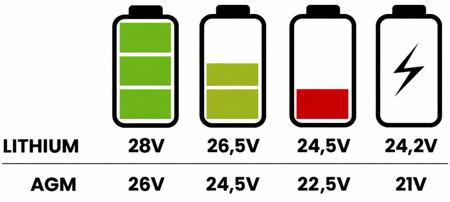
1. Full Charge Level
28V (Lithium) | 26V (AGM)
At this level, the batteries are fully charged and no additional energy can be stored.
What this means for you:
Your FD20 has reached maximum available battery capacity and is ready for operation.
2. Resuming Level
26.5V (Lithium) | 24.5V (AGM)
Once the battery voltage reaches this level, the FD20 can automatically resume autonomous operation.
Important:
If the robot previously reached the Shutoff Level, it will not restart automatically. A manual restart in the field is required.
What this means for you:
The robot usually takes care of restarting itself when enough power has been recovered, reducing the need for operator intervention.
3. Idle Level
24.5V (Lithium) | 22.5V (AGM)
When the battery reaches this level, the FD20 waits 10 minutes before pausing autonomous operation. Essential systems remain active.
This standby mode allows the robot to automatically resume work once sufficient energy is available again, for example after solar charging during daylight hours.
What this means for you:
The robot is conserving energy while remaining ready to continue working when conditions improve.
4. Shutoff Level
24.2V (Lithium) | 21V (AGM)
At this level, the FD20 powers down completely to protect the batteries.
A manual restart is required once the batteries have recharged sufficiently.
What this means for you:
This safety feature protects battery lifespan and prevents deep discharge damage.
Best Practice for Reliable Operation 💡
For the best balance of performance and battery longevity, only restart the FD20 when the battery voltage has reached at least 26.5V.
Starting with a healthy charge level gives the robot enough energy reserves to work efficiently while continuing to recharge from solar power throughout the day.
Keep Solar Panels Clean for Maximum Uptime ☀️
The FD20 relies on solar charging to maintain long operating hours in the field.
To get the best performance:
- Regularly inspect the solar panels for dust, dirt, and debris.
- Pay special attention at the beginning of the season and after long periods of storage.
- Clean panels whenever you notice reduced charging performance.
Why it matters:
Clean solar panels improve charging efficiency, increase available operating time, and help the robot stay productive throughout the season.