
Before continuing, complete CREATE A FIELD 1/3.
These settings determine how your FarmDroid robot seeds, weeds, and navigates the field, helping you achieve the best results for your crop and field conditions.
These settings determine how your FarmDroid robot seeds, weeds, and navigates the field, helping you achieve the best results for your crop and field conditions.
HMI Page 3.3: Field Settings
Work Width
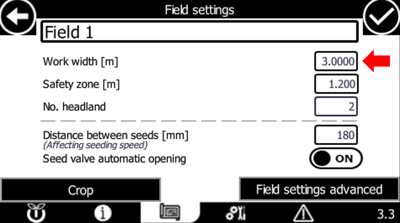
The Work Width defines the total width covered by your robot during operation. This value is set according to the robot's current mechanical configuration and should only be changed if the configuration has been modified, for example:
- Adding active units
- Removing active units
- Making other hardware changes that affect the robot's operating width
Important: Do not adjust the Work Width unless the robot's mechanical setup has been changed. Incorrect values can affect field accuracy and robot performance.
Safety Zone
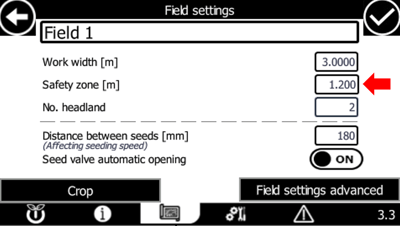
The Safety Zone is a protective buffer around the field that gives the robot enough space to turn safely at the headlands without colliding with obstacles located outside the field boundary.
In most situations, the Safety Zone should remain at its default value.
You may need to adjust the Safety Zone if:
- The robot's mechanical configuration has changed.
- You want to reduce the turning area around the field.
Important: While the software allows a limited reduction of the Safety Zone, it cannot be reduced to zero. If you choose to use a smaller Safety Zone, you are responsible for ensuring there is sufficient clearance for the robot to operate safely without risking damage to people, property, or the robot itself.
Default Safety Zone Calculation
The standard Safety Zone is calculated as:
2.7 m − (Work Width ÷ 2)
This calculation ensures the robot has adequate space to complete turns safely while maintaining efficient field coverage.
Number of Headlands
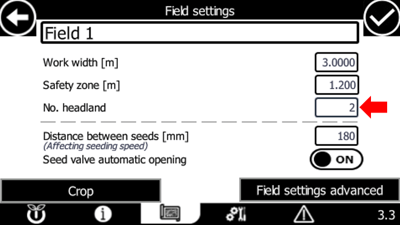
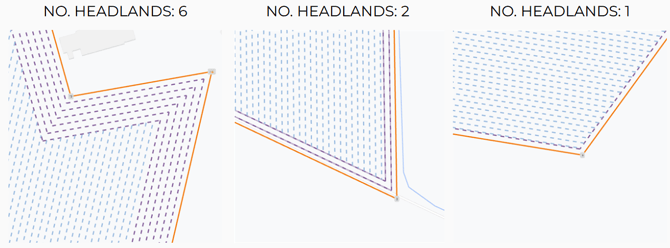
Headlands create an area around the perimeter of the field. This space allows machinery and equipment to turn without damaging crops.
Set the Number of Headlands to define how many perimeter passes the robot creates.
Why it matters:
- Provides turning space for FD20 and other machinery.
- Helps improve accessibility during field operations.
Examples:
Set the Distance Between Seeds
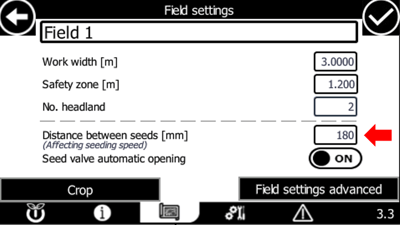
Distance Between Seeds (mm)
Enter the desired spacing between seeds within the same row.
This setting directly affects plant population and crop density.
Important: To enable inter-row weeding, the minimum distance between seeds must be 100 mm.
Configure the Seed Valve
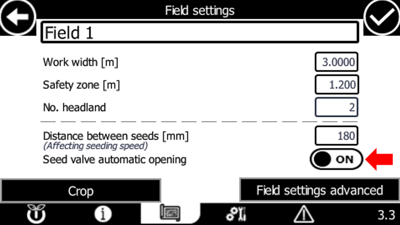
The correct seed valve setting is provided by FarmDroid as part of your seed test certification.
Seed Valve ON
The robot automatically opens and closes the seed valve to achieve accurate seed placement.
Recommended when:
- Seeds are placed in portions or groups.
- The distance between seeds is at least 10 cm.
Seed Valve OFF
The seed valve remains continuously open throughout seeding.
Recommended when:
- Using very high-density seeding.
- The distance between seeds is lower than 10 cm.
Tip: Always use the seed valve setting recommended during your seed certification process.
Next Steps
After configuring these settings, review all field parameters before starting seeding. Proper setup ensures accurate seed placement, efficient weeding, and smooth robot navigation throughout the season.