
Across multiple countries, crops, and soil types, one message became clear: seeding performance starts long before the seed enters the ground. While autonomous seeding technology can deliver high precision, the quality of field preparation remains the single biggest factor influencing emergence, uniformity, and overall crop success.
Field observations from Australia, Finland, Ireland, Denmark, and Romania demonstrate how soil structure, surface uniformity, compaction, and residue management directly affect seeding outcomes.
Australia: When Clods Reduce Precision
Crop: Cabbage
The Australian field showed a rough seedbed with large clay-loam aggregates.
Key observations:
- Large soil clods created an uneven planting environment.
- Small cabbage seeds could move after leaving the seed tube.
- Extra machine weight was needed to properly press the soil.
Customer takeaway
Small-seeded crops are particularly sensitive to seedbed quality. Even when seeding equipment performs correctly, large soil aggregates can cause seed displacement and inconsistent emergence.
Best practice: Invest additional effort in seedbed refinement when planting very small seeds such as cabbage, carrots, onions, and lettuce.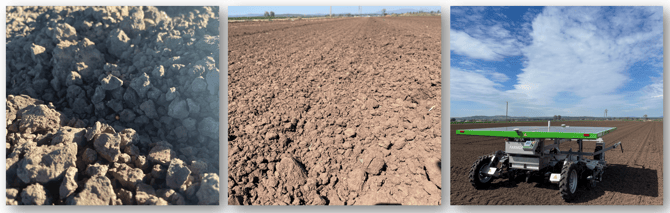
Finland: Good Surface, Excessive Firmness
Crop: Sugar Beets
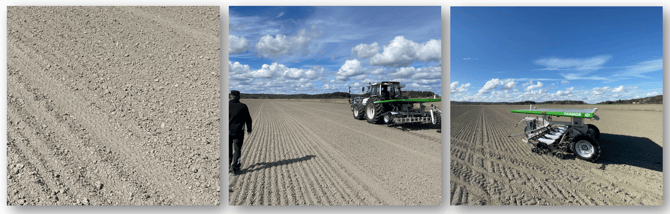
Finland presented almost the opposite challenge.
The field displayed:
- Fine soil particles.
- Excellent surface uniformity.
- Very little weed pressure.
However, the soil had become slightly over-compacted, reducing the natural structure of the seedbed.
Customer takeaway
A field can look visually perfect while still limiting crop performance. Excessive compaction reduces pore space, affects water movement, and can restrict root development.
The autonomous seeder performed successfully after tyre pressure adjustments improved traction on the hard ground.
Best practice: Aim for a firm seedbed, not a hard one.
Ireland: Too Soft for Consistent Performance
Crop: Sugar Beets
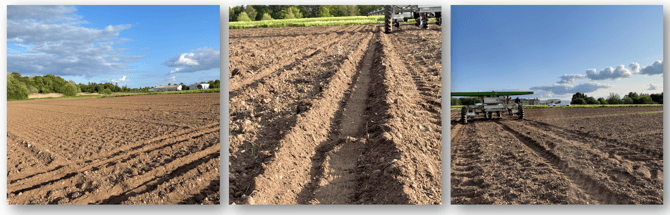
In Ireland, the soil particle size was acceptable, but the seedbed lacked firmness.
Observations included:
- Uneven and wavy surface conditions.
- Excessively soft soil.
- Robot sinking during operation.
The field would have benefited from additional rolling before seeding.
Customer takeaway
Many growers worry about over-compaction, but insufficient compaction can be equally problematic.
When soil is too loose:
- Equipment depth control becomes more difficult.
- Ground contact varies.
- Seed placement consistency suffers.
Best practice: Use rolling when necessary to create a stable platform before planting.
Denmark: Residue Management Is Critical
Crop: Red Beets
The Danish field highlighted the impact of vegetation residues.
Field conditions included:
- Good compaction levels.
- Uneven surface.
- Significant couch grass residue.
- High weed pressure before preparation.
Although the soil itself was workable, residue accumulated on seeding components and required frequent cleaning.
Customer takeaway
Even advanced seeding systems struggle when excessive residue interferes with openers and soil-engaging components.
Residue management is not only about weed control. It directly affects machine productivity and seeding accuracy.
Best practice: Minimize surface residues and perennial weed pressure before planting operations begin.
Romania: The Benchmark Example
Crop: Onions
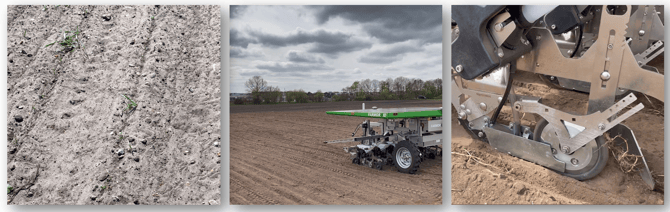
Romania provided the clearest example of a well-prepared seedbed.
The field delivered:
- Uniform surface conditions.
- Weed-free preparation.
- Balanced soil firmness.
- Good top-layer structure.
The result was excellent seeding performance.
Customer takeaway
The best fields are not necessarily the finest or the firmest. They achieve the right balance between soil structure and compaction.
This case demonstrated how proper preparation allows seeding equipment to operate at its full potential.
Best practice: Create a level, weed-free surface with moderate compaction and sufficient soil structure.
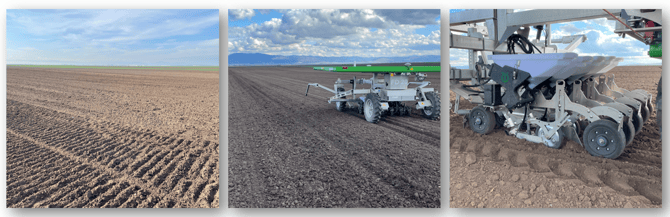
Common Lessons Across All Five Countries
Although the crops and soil types varied considerably, the same principles repeatedly emerged:
| Challenge | Impact on Seeding |
|---|---|
| Large clods | Reduced placement precision |
| Excessive compaction | Restricted soil structure and traction issues |
| Insufficient compaction | Poor depth control and machine stability |
| Uneven surfaces | Variable seeding depth |
| High residue levels | Component blockage and reduced efficiency |
| Balanced seedbed conditions | Consistent seed placement and emergence |
The Main Message
Autonomous seeders and precision planting technologies can only perform as well as the seedbed allows.
The experiences from Australia, Finland, Ireland, Denmark, and Romania show that successful seeding is not about creating the finest soil possible. Instead, it is about creating the right balance of surface uniformity, soil structure, compaction, and residue management.
When these fundamentals are in place, the technology can do what it was designed to do: place every seed accurately, consistently, and under optimal conditions for emergence.