
Before You Start
To ensure a smooth setup process, make sure that:
- The droid is mounted on the field bracket for easy transport around the field.
- The robot has a FIXED RTK signal before you begin mapping.
Step 1: Open Field Setup
From the main HMI screen, swipe right to Page 3: Field Setup.
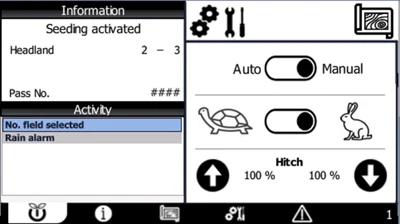
Step 2: Select a Field Slot
Open the field selection drop-down menu and choose an empty field slot.
⚠️ Important
Selecting a slot that already contains a saved field will permanently overwrite the existing field and all associated settings.
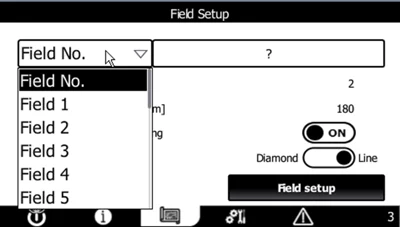
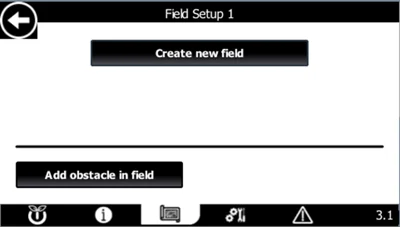
Step 3: Create a New Field
Tap Create New Field to begin the setup process.
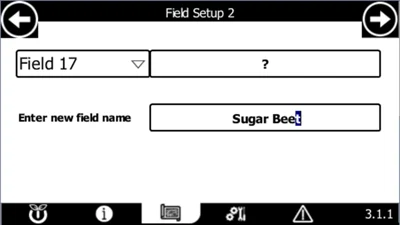
Step 4: Name Your Field
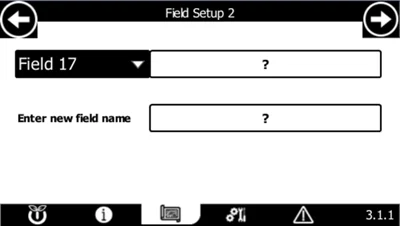
Tap the ? icon and enter a name for your new field.
Choose a name that is easy to identify later, especially if you manage multiple fields.
Step 5: Save Corner Point 1
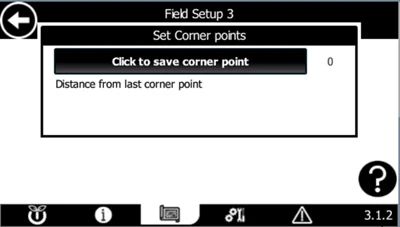
Drive the robot to the first corner of your field and save the position.
💡 Tip
The saved position corresponds to the location of the Front GPS Antenna.
✅ Recommended Best Practice
Save Corner Point 1 at the location closest to your usual field access point, such as a gate or the area where the droid is typically unloaded.
Corner Point 1 cannot be repositioned once the field has been completed and saved, so choosing the most practical starting location can make future operations easier.
Step 6: Continue Mapping the Field Boundary
After saving Corner Point 1, you can:
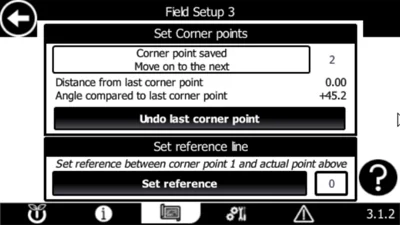
- Continue to the next corner point and keep mapping the field perimeter.
- If necessary, select Undo Last Corner Point to reposition Corner Point 1 and save it again.
📝 Note
The Undo Last Corner Point option is available each time a new corner point is saved.
Step 7: Complete the Field Perimeter
Continue driving the droid to each corner of the field and save every point until the entire boundary has been outlined.
The more accurately the corner points represent your field edges, the more accurately the robot will operate within the area.
Step 8: Define the Reference Line (AB Line)
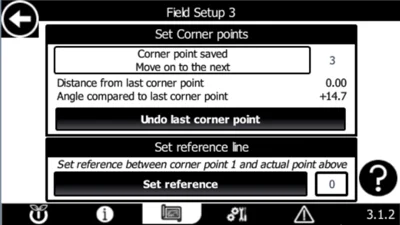
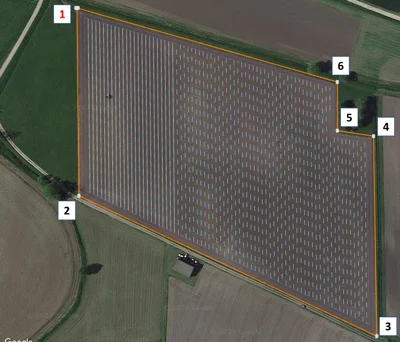
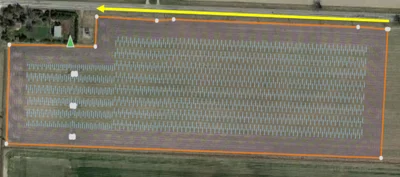
Once all corner points have been saved, define the Reference Line (AB Line). This line determines the direction in which the robot will work across the field.
- The reference line always starts from Corner Point 1.
- You decide which corner point the line should point toward.
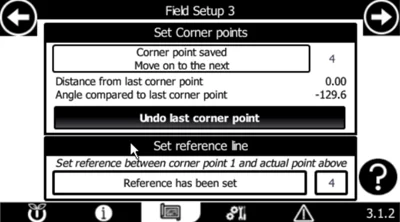
- Select the 0 field and enter the number of the desired corner point.
💡 Tip
Choose a reference line that allows the robot to complete the field with the fewest possible turns.
For example, if the reference line runs between Corner Point 1 and Corner Point 2, all working rows will be generated parallel to that line.
Choosing the wrong reference line can lead to unnecessary turns, reduced efficiency, and longer operating times.
Step 9: Continue to Field Review
Once the reference line has been set, tap the arrow in the top-right corner to continue.
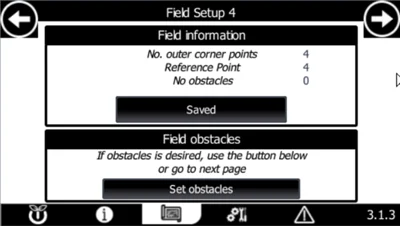
Step 10: Review and Save Your Field
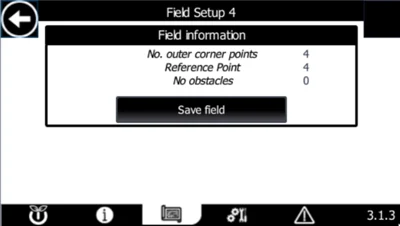
Verify that the field information is correct:
- Number of corner points defining the field boundary
- Selected reference point for the AB lines
If everything looks correct, tap Save.
If changes are needed, use the back arrow in the top-left corner to return and edit the setup.
Step 11: Map Any Obstacles
If your field contains obstacles such as:
- Electricity poles
- Wells
- Water outlets
- Other permanent objects
Select Set Obstacles to map them.
📝 Note
Each obstacle must be defined using a minimum of three corner points.
The mapping process is identical to field creation:
- Drive the droid to each obstacle point.
- Save each position.
- Complete the obstacle outline.
After mapping an obstacle, you can either add another obstacle or proceed with the field setup.
Step 12: Continue to Field Settings
Your field boundary and obstacle mapping are now complete.
Next, configure how the robot will operate within this field by following CREATE A FIELD (2/2): Field Settings.
👉 Continue to: CREATE A FIELD 2/3